Monday, July 12, 2010

Edits, Edits, Who’s Got The Edits?


What is your editing process? As a writing team, ours is probably different from what you might do. Basically, Arwen starts a story – writing 1500 words. She happily sends it off to Cai then sits back waiting for the accolades to roll in. (Of course, it could be Cai who starts the story, in which case, just reverse all the names below. LOL)

Cai whips out her proverbial red pen and proceeds to edit the snot out of Arwen’s clichés and grammar mistakes. She then adds 2500 brilliant words and sends it back to Arwen just knowing that Arwen is going to delightedly accept the changes and breeze through her additions.

Arwen growls as she admits to 75% of Cai’s changes as being good, but fights back on 25%. Then Arwen hauls out her tarot deck to heavily correct Cai's plot gaps and character flaws. She then adds the best 500 words of her life and hits “send.”

Cai accepts 10% of Arwen's rejections on her original edits. Then she sighs and accepts 75% of Arwen's edits while massaging her temples and fighting back on 25%. She reads the minimal effort from Arwen and decides to wait a day or so before adding or editing any more. Adding another 2500 words after a few days, Cai sends the whole shebang back to Arwen and waits with bated breath for Arwen to read/edit and send it back again.

By the time we reach the end of the first draft, we've got a pretty good handle on what is working and what scenes need to be completely re-worked. All silliness aside, this is how we edit as we go without rewriting the same three pages ad infinitum. We find that this gives us a fairly clean first draft. Then we can spend time going back over the whole manuscript tightening character development and making sure our GMC (Goal, Motivation, Conflict) for each character is fully developed.

When we're both ready to call it “done,” our next step is to find a beta reader or two. We think we know where the weak spots are, so we ask our beta readers to concentrate on those areas, but also to point out anything else they come across in their reading that jars them out of the story for whatever reason. With their suggestions in mind, we read the story with fresh eyes and make whatever changes we feel will strengthen the story. In the end, that is what is the most important. What makes the story truly work.

Then and only then are we ready to send it off to an editor with a query letter attached. So what is YOUR process? Do you write, edit, write some more? Or do you write the entire manuscript then go back and edit each scene, each chapter, etc., Let us know, we’d love to hear your thoughts.

Sunday, July 11, 2010

How to Make the Most of Your Pitch Opportunity

Businesswomen talking
The RWA National Annual Conference takes place in two weeks, and the internet is abuzz with tips on how to sharpen your pitch.

Entire workshops are devoted to squishing characters, plot, goals, motivation, and conflict into the time allowed. With proper preparation, most writers will get a request from the editor or agent they pitch.

You might consider that a success, but the ultimate goal is to sell your book. There’s more to sales than simply advertising. And there’s more to pitching than simply getting a request for a partial. If you want to sell your book, you have to leave your editor/agent feeling like you were worth the time she spent on you. That’s customer satisfaction in the world of publishing.

Speaking of customer satisfaction, think about the last time you felt like you’d been cheated by a salesman. Chances are the problem fell into one of the following categories:

  • The product or service was not as advertised.
  • The work was not performed on time.
  • There was no customer service after the sale.

    Woman executive talking to male worker
    Let’s see what these problems tell us about how we should make the most of our pitching opportunity.

    The Product Needs to Match the Pitch
    When you pitch at a conference, you are presenting yourself as a serious writer. Inherent in that is a promise that you have taken the time to learn the craft, to finish your manuscript, and polish it to industry standards. If you haven’t done these things, then you’re misrepresenting your product. Don’t pitch before you’re ready.

    No matter how well you write, the tone of your pitch needs to match the tone of your novel. If your pitch is plot-based and the novel is character-driven, the editor/agent is going to feel like you misled him. Don’t promise
    Star Wars and send in Little Women.

    Desk calendar
    The Product Needs to be Delivered on Time
    If you’re an unpublished author, your book needs to be polished and ready to send before you pitch it. Ideally, you would send it as soon as you got done pitching. But sometimes, something you see at the conference might give you an idea on how to tweak it and make it better. If that’s the case, it’s best to be upfront with the editor/agent and agree on a time frame for submission. You don’t want to leave them with the impression that you can’t be counted on to make your deadlines.

    Customer Service after the Pitch
    So you’ve pitched your novel, and sent in the partial. If you’re lucky, this will result in a request for a full. But you might be advised to “revise and resubmit.” This is where you get to show off your customer service skills. Listen carefully and make sure you understand what they’re asking you to do. If you agree to the changes, then make them as quickly as you can while maintaining the quality of writing. The editor/agent will be taking note of how easy (or difficult) you are to work with.

    I hope these tips have given you something to think about as you prepare you pitch.
    For those of you who have pitched before, please share your expertise. What’s the best pitching advice you ever received?


Saturday, July 10, 2010

10 Reasons Being A Writer Rocks


Sometimes, the writing life can get you down—the rejections, the solitude, the relatively low chances of big pay…

But this weekend, I thought it would be fun to think of all the reasons why being a writer rocks. Please add your own positive ideas to this list—and spread the love! What’s your favorite thing about being a writer?

10. You can work in your PJs.

9. A trip to the bookstore is a tax write-off.

8. “Not now, I’m reading this book,” is akin to “I can’t, I have a meeting.”

7. It’s weird if you don’t hear voices in your head.

6. When you go to a job seminar, you actually have fun!

5. What other job puts such a high value on otherwise useless information?

4. If your coworker is annoying you, get the leash and take him for a walk.

3. Writing is the perfect fusion of acting (inhabiting character), drawing (indulging in detail of space), performance (a show offered with unmatchable intimacy), social sciences (the study of human behavior), and imagination (possibility is infinite!).

2. To a writer, everything in life--from a skinned knee, to a divorce, to a broken car, to the bottom of a baby's foot--is filled with the potential for inspiration. Everything has practical value in the writing life.

1. With book people, you’ll find kindred spirits everywhere you go.

Best and love,

Lisa Dale
Come join me for book giveaways, author interviews, and book talk!

Thursday, July 8, 2010


The Terrible Tales of a Technophobe


Don’t you just hate them? Well, maybe hate is too strong a word. Resent might be a better one.

I’m talking about those people who can turn on their computer and get it right, first time. No problems. No hassle. No fuss.

Or maybe a friend shows you what to do on their computer. Looks so simple, yeah?. Uh uh. You can’t wait to go home and try it on yours. But just you wait. What worked on theirs, doesn’t work on yours.

In fact, it’s got so bad now, that even I end up laughing at myself. I expect it to go wrong, and so it does.

When I sign up for a course that tells me what I’m supposed to do, and follow instructions to the letter, my computer is the one that never plays ball. There’s always a different response to what is expected and the course convenor ends up signing me up manually. I just hope and pray that nothing ever goes wrong because I wouldn’t know how to get back.

Surely, the way to stop bothering friends and family and learn from the bottom up is to buy the Word Book for Dummies. That will help me get over the many problems technophobes must endure. Won’t it?

Well, I brought the book that would turn all my computer dreams into reality, confident that all the hassles of compterdom were behind me.

But oh no. Nothing that simple for you, my girl. You see, I never got the response from my friendly PC that the book said I would, no matter how many times I went back to the beginning and started again. Did I miss something? A vital point? You already know the answer to that.

Maybe it’s a conspiracy by the powers that be, and they are having a laugh at my expense.

And take something as simple as this blog. It will be fun to join my chapter sisters in a mutual blog, won’t it? Please?

Uh uh. Problem from the word go. So if you are reading this sad tale, it’s thanks to Mona and her step-by-step, handy-hold instructions that I got it right.
I hope.

Wednesday, July 7, 2010

Joanne--Sharing the writing of Dave Barry

I am a big fan of the author and column writer, Dave Barry. His writing is thoughtful, witty, and absolutely hilarious. Many writers mention Stephen King's book "On Writing", but not many know that Dave Barry and Stephen King are good friends and play in a rock band together.

Following is a classic Dave Barry post on writing and snakes:

The other day I was sitting at my desk in my home office, doing what I do all day, which is frown at my computer screen. This is tiring work, so roughly 35,000 times a day I have to take a break to eat something, or drink something, or scratch something. At this particular moment, I reached to my left, to pick up my can of Diet Coke, and EEEEEEEEEEEE. That is the screaming sound my brain made when it realized that my hand was, at most, two inches from a live snake. Really. As a south Florida resident, I'm used to having ants on my desk, but they are friendly, harmless, and easy to smush. Whereas this was a full-blown snake, coiled for attack, with its head reared up and its tongue flicking out toward me, which is how snakes communicate the message: "Hah! Perhaps you wish to die for your Diet Coke, Mister No-Topic Writer Man!"

Summer Reading

by Dawn Marie Hamilton

On the east coast of the US, Summer 2010 hit hot, hazy and humid with record temperatures. I stopped by the county library yesterday, and the reading room was packed. Are heat waves good for book sales?

Since I've been writing toward publication, I've met many other writers through my local RWA chapters and online writing groups, both published and unpublished. Need I mention, my TBR pile has grown and is threatening crashing to the floor? I managed to carve out some time to read over the last month. So what have I been reading?

Being of Scottish heritage, I have a passion for all things Scottish and love to read Scottish historical romances. I enjoyed Highland Dragon by Kimberly Killion. I met Kimberly through one of my Yahoo loops, Writers of Scottish Romance.

I also love paranormal romances heaped with great world building. And I prefer series. Series give me the opportunity to meet beloved characters again in follow up books. A couple of years ago, I was fortunate to attend a workshop on world building conducted by JR Ward and Jessica Andersen at the NJRW conference. Inspiring. I added their books to my TBR list and was floored when I read them. Couldn't put them down.

Lover Mine is the latest book in JR's The Black Dagger Brotherhood series. In preparation for the release date, I reread all seven previous books in the series. Great worldbuilding, great character development, great reading.

I most recently read Jessica's Sky Keepers, book three of The Final Prophecy novels. I'm looking forward to getting the latest release Demon Keepers in the mail. Where will you be on December 21, 2012?

So what are you reading? Let me know by leaving a comment.

Tuesday, July 6, 2010

Writing Contests-The Pleasure and The Pain

Most writers have entered a writing contest or two and writers’ feelings about writing contests seem to be mixed. I’ve read posts on chat loops from authors who’ve had bad contest experiences with critical judges and poor feedback, conversely, I’ve also heard of authors who have sold their first book after winning a contest.

The topic of writing contests is a pertinent one for me because I’m one of those authors who sold a first book through a writing contest. I won the American Title IV contest run jointly by Dorchester Publishing and RT Bookreviews magazine and a publishing contract was the prize for winning.

The American Title contest was unlike most writing contests, being based on American Idol. For five rounds, character studies, story summaries, or book excerpts were published in RT Bookreviews magazine. Each round, the writer whose book received the fewest votes was knocked out.

I also have experience of many conventional writing contests where judges, usually fellow writers, judge the first round, marking and giving feedback on a score sheet before the top three or four entries are passed on to an editor or agent for final judging. There is definitely an element of luck involved. Some judges never mark high no matter how great the entry, while others are overly critical or just plain wrong in their assessment and advice. The funniest comment I ever received from a judge was that my English character sounded too American and I needed to research British English. If only she’d known that I’m British!

Despite all their faults, I found writing contests tremendously helpful in giving me feedback on my writing and in helping me grasp the subtle differences between British English and American English. In the early days when I was new, some contest judges put a lot of time and trouble into explaining to me how to improve my writing. Those judges alone were worth the entry fee.

Later when I started to final in and win contests, the boost to my confidence helped me to forge on toward the goal of publication with renewed enthusiasm. For me the ultimate contest achievement for an unpublished romance author was to final in the Golden Heart. The experience of attending the Romance Writers of America National conference in San Francisco as a finalist was so much fun I wouldn’t have missed it for anything, and the camaraderie among the group of finalists is still important to me two years on.

My writing contest experience has generally been good, and I’d recommend unpublished romance writers to enter RWA chapter contests to gain feedback on their work and also to get in front of the agents and editors who judge the finals. My one proviso would be to check the score sheet first. It is often available on the website of the chapter running the contest. If not, the contest coordinator should let you have a copy. I also recommend that you ask if judges are required to give a reason when they knock off points. Certain contests are known for having good judges and giving good quality feedback. Two that come to mind are The Golden Gateway contest run by FTHRW, an online chapter of RWA, and another is The Golden Pen, run by The Golden Network.

I have recently entered my first book The Magic Knot in a few contests for published books, so I’m now entering a new realm of writing contests. Once again, I feel like the new kid at school!

I’d love to hear your experience of writing contests if you’re a writer. If you have entered contests, has the experience been useful or not? If you have chosen not to enter, why not?

For anyone who is interested in entering a contest similar to The American Title contest where first prize is a publishing contract, Alicia Condon is currently accepting submissions in Kensington Brava's Writing With The Stars contest.

Saturday, July 3, 2010

Summer Garden Surplus

It’s summer and the livin’ is…overwhelming


It’s that time of year—you know—when gardeners start desperately searching for people to dump produce on. If you were unwise enough to plant squash, you’re now starting to dread looking under those leaves of your plants because you know you’ll find another basket-full of squash you have to pick. Then, you actually have to use it somehow, when your family is giving you dirty looks when you say in a spritely voice, “We’re having squash tonight!”
Believe it or not, this picture includes a giant cucumber (foreground) that I forgot to pick when it was a sweet young thing. Perhaps I’ll have to make pickles out of it.

One of the nicest things about growing your own produce is that you can grow odd varieties that you just don’t find in the store.

Around here, people get downright sneaky. Neighbors will visit for no reason at all, armed with a plastic shopping bag stuffed full of squash, tomatoes and peppers. Even if you spot them through the door curtains and refuse to answer, they’ll leave those little gifts for you. And of course, a day or two later, they’ll be dodging you as you visit them with armfuls of produce you think they might just need because, after all, they probably gave you all the ones they had that week.

Or, you may just find that squash, tomatoes and peppers are a lot cheaper at the store this time of year.

No matter…this blog is devoted to what the heck you can do with all that produce.

Sure, you can wash it, slice it up and freeze it. Or can it.

Or, you can make your family eat it, even if they’re heartily sick of it.

The nice thing about squash is that it has a mild flavor and can be disguised in almost anything your family will eat. So I thought I’d share a few of our favorite ways to use the produce that is so prevalent now.

Spaghetti

Spaghetti is the single most effective way to force veggies down the collective throats of your family without too much of a struggle. If they tend to like veggies, then no worries, you just leave them in recognizable condition. If your family hates veggies, then you can pull out the Salad Shooter to grate them so your kids (and husband) will never know the difference when you add them to soups, meatloaf, and sauces.

So here is one of our favorites at this time of year.

Take any squash, peppers, onions, eggplant—basically, whatever you have on hand, and slice it up. I tend to slice it into thin slices as if I was making pickles, and then cut those into quarters. Sauté in olive oil, then add some crushed/chopped garlic. Cook a couple of minutes over med-high, just until everything is tender.

Add a can of fire-roasted tomatoes (or any fresh tomatoes you have, diced) and a can of diced, Italian tomatoes. Then add about 2 Tbsp of tomato paste. If your family likes their sauce sweet, then grate some carrots finely and add those. Cook for about two-three minutes on med. Add about a teaspoon of Italian herbs and maybe a fistful of fresh basil chopped up.

If you like meatballs or meat in your sauce, add the meatballs or place the cooked veggies in a bowl, cook the meat, then add the veggies again. When I’m in a hurry, I use frozen meatballs and it takes about 10-15 min of cooking in the sauce for them to warm up. If I’m ambitious, I bake meatballs ahead of time and freeze them, so I just need to grab a bag.

You can also substitute tofu for a vegetarian twist, or no meat at all.

While the sauce cooks, cook your spaghetti.

This is a terrific way to use all of that produce and get a few more helpings of veggies into your life. When veggies are in season, I’ve been known to just use fresh tomatoes in place of the canned. And, you can also freeze this to use in the winter months when veggies are more expensive. I just fill one of those quart freezer bags and freeze it—no problem.

It also makes a great sauce to use for lasagna or any other Italian meal.

Zucchini Pancakes

I also love zucchini pancakes. On Saturday morning, I go out and pick a few baby zucchini and yellow squash and then grind them up. I add some grated onion (I like Vidalia), a few spoonfuls of flour and a beaten egg. I stir that together (add more flour if necessary) until it has the consistency of pancake mix. Then I fry it like a pancake and top with a bit of butter when serving.

The recipe depends upon how much zucchini/squash you grind up. I do about a cup, add 1 beaten egg, and about 2 Tbsp of grated Vidalia, along with about 2 Tbsp of flour more or less to get the right consistency. This is a rough estimate because I don’t measure it—I just grate up whatever baby squash I have and then add whatever I need to make something similar to pancake batter.

It’s a great breakfast or side dish for dinner. You can serve it whenever you would normally serve potato pancakes.

Some folks find they want the grated squash softer. If that is the case, after you grate it, simply nuke it in the microwave for one or two minutes before you mix it into the rest of the ingredients.

It’s simple and delicious.
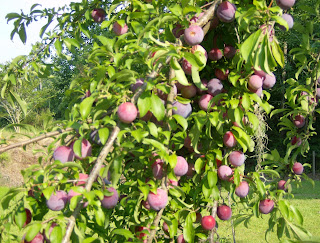
And...I just walked around our garden and discovered...MORE PLUMS! I've already made 24 pints of plum jam. Sheesh. Guess I'll have to think of some creative ways to use plums now, in addition to the squash, tomatoes, and cucumbers. Maybe it's time to learn how to make wine...
Have a happy and productive summer!

Amy Corwin, author and overwhelmed gardner

Friday, July 2, 2010

Celebrating Number 15!

I've been writing romance for a lot of years. I wrote and completed and submitted a lot of manuscripts before I made my first sale. My family was there for all of it, supporting me through the good and bad, and celebrating with me when I made my first sale. And each sale after that.

My daughter kept track of each sale, keeping count and letting me know that it was the 5th sale or the 10th and so on. Early on she'd joked that after I made my 15th sale, we were going to have to go get tattoos together. Well, after writing for years, 15 sales seemed like a distant goal, maybe never even attainable. Guess which contract I just signed. Yep... See Me, my erotic short for Samhain, was my 15th sale.

So this past Thursday, my daughter and I went to Wild Side Tattoo and Piercing. Everyone there was great and when they found out I was a tattoo virgin, they did all they could to make sure my first experience was a good one. I explained what I had in mind and they drew up the perfect design. I was pretty nervous, even though I was excited. I had no idea how I was going to react to the pain, but I was pretty proud of myself. I spent over an hour in the chair and walked out with this beautiful celebration.


If you can't tell from the photo, there are 15 hearts to signify my 15 romance sales. With any luck, I'll be adding some more little hearts in the future...

Natasha
www.natashamoore.com

Thursday, July 1, 2010

Envy


Right about now, the green eyes of envy kick in. I mean the 'RWA National Conference envy' of those of us not going. Conference envy is not a pretty sight. It can make the most calm, well-mannered people become someone they don’t know and don’t like very much. Something like a witch with a B.
For example, about now, the yahoo loops and chapter boards start heating up with newbies asking all the ‘about conference’ questions. Chapter presidents are asking for head counts for conference dinners and get-togethers. If you are not going to the conference this gets those ‘green eyes’ going.

You start whining; to yourself, to your family, and to other writer friends. It’s not pretty and you know it, but you can’t help yourself.

Yes, you can. There are other options than National. Maybe not as big. Maybe not as many friends will be there. But, there are options.

1. Take extra workshops: the boards will be slow, now may be the time to take one or two workshops this month. You are in a lull period with agents and editors gearing up for National. Take time to take a class or two you’ve been meaning to check out.

2. Romance Divas has a Not Going To Conference Conference. They have pitch practice, workshops, networking, door prizes, etc. Last year I won my name in a book. Cool!! Sign up is free and the Divas are fun at any time of the year. http://www.romancedivas.com/

3. Spend some time on your current manuscript. Things will slow down online at this time of year. Spend the time polishing your baby. You have time to try new things; a different POV, a different kind of character, etc. Try something new while the pressure is low.

4. Do something for yourself. Never had a mani/pedi? Or a massage? Maybe now is the time to take time for you.

Just remember, nobody likes the green eyes of envy. Especially you.