I went to college. And actually graduated. So of course I can write, right?
Right, sort of. I started with a fiction-writing, critique-group class at a Community College. That was an eye-opener. Sure, I could write. However, that's when I began to understand the wide gulf between my prose and that of published writers.
I searched in libraries and used bookstores for 'how to' books that would help me. I found many. I found truly valuable help in few.
Now that I think I write rather well for the two genres that interest me, I look back and remember only two books that had a significant impact on my writing skills.
The first was: Stein on Writing, by Sol Stein. It answered the question, "How should I write if I want to get published?"
The second was: Self-Editing for Fiction Writers, by Renni Browne and Dave King. It answered the question, "How should I write if I want to impress agents and editors with my professional-caliber skills?"
I mention these two books because they are the only books that I have kept and re-read. All the others didn't seem to 'pop' for me, I guess.
Now it's your turn. Tell me what book on writing wowed you, and made you keep it, and made you re-read it once in a while.
Thursday, August 19, 2010

Tuesday, August 17, 2010
First POV by Carolyn Hughey
When I first began writing contemporary, I decided to write in First POV. My peers tried to discourage me from using this method saying publishers didn’t really like First POV, and my heroine had to be in every scene. And they warned me about how difficult it would be to get the hero’s point of view across to the reading audience.
Well after much consternation and research on the subject, I decided First POV for my contemporaries was it. Hey, if it was good enough for Janet Evanovich, by golly, it was good enough for me. I mean, it wasn’t like I hadn’t tried to write that same story in Third, I did, but it just didn’t have the same ring my snarky heroine needed for those fast comebacks in any given situation.
Here’s what some of my research produced: First person point of view is the most reader friendly. It’s intimate. The reader feels like the character’s best friend. In fact, the viewpoint character will often confide in the reader things he wouldn’t tell his best friend. “The Writing Craft Blog”
So, how can this be so bad? It’s not. To me, reading a fun story in the character’s point of view is like hanging out with her, having a cup of coffee, or better yet, a glass of wine and snacks. I’m giving my readers a front row seat to my heroine’s inner most secret thoughts. Things she might not tell her best friends for fear they’ll laugh at her. That’s means you guys are better than her best friends. You’re like her confidante.
So the humorous contemporaries will remain in First POV, and my Mysteries will be written in Third—for obvious reasons.
Oh and by the way, my hero’s aren’t having a tough time trying to express those views, feelings, or comments. You’re getting his thoughts by his actions, and she’s having a hellava good time sharing them with you.
Carolyn Hughey
[Carolyn, sorry for posting late. I am traveling and in between planes.]
Saturday, August 14, 2010
Dare to Dream
I started dreaming of seeing my stories published after attending my first conference, Fun in the Sun, organized by my local chapter, Florida Romance Writers, in 2004. I had one story written and was just starting on the other, and yet my new friends in the chapter encouraged me to pitch both. I received four requests that lead to rejections but you should have seen the boost of energy the requests gave me. I wrote daily while imagining myself signing books, attending interviews, becoming the next Nora Robert. I dreamed and dreamed ...

I attended more conferences, workshops, seminars, chats and learned to network with fellow writers who shared my dreams. Here with Carolyn Hughey and Marlene Urso at RWA 2004 in Dallas.

Carla Capshow from the FTHRW chapter won her first Golden Heart. She won a second in 2007. We congratulated her and dreamed of Golden Heart awards.
I met Nora Robert at the 2004 RWA Conference in Dallas and ogled her TWO little statuettes. She let me hold them.
The dream materialized at a FRW conference. I pitched TO LOVE A HERO to Raelene Gorlinski from Cerridwen Press, received a request and later my first contract. I was ecstatic.


My friends surprised me with a party at Olive Gardens to celebrate the release of my first book as ebook. I signed the cover for them.
The dream continued for me and my critique partner. Helen Scott-Taylor won the Romantic Time American Title and was honored at the 2008 RT conference in Pittsburg.


In 2008 I sold my medical romance BABIES IN THE BARGAIN to The Wild Ro se Press.

My friend Terri Gary from FTHRW won the RITA.
And my critique partners Joan Leacott (from Toronto) and Helen Scott-Taylor (From England) came to attend the conference.
In 200 9 TWRP published my second book, Rx FOR TRUST.

BABIES IN THE BARGAIN won the 2009 Best Romance Novel of the Year at Preditors & Editors Readers Poll and the 2009 Best Contemporary Romance at Readers Favorites.
The 2010 RWA in Orlando was a blast.


Here is a picture of my Playground loop. Most are FTHRW members. And another picture with Terry Spears at the fantastic cocktail organized by our dear Prez Carolyn. Terry told us about her successful career.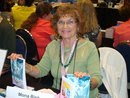

I had my first National signing. Imagine Stephanie Laurens, the Regency bestselling author was sitting a few tables from me. Clarissa Southwick from our own Voices blog was a finalist in the Golden Heart.

Angi Plat from my Playground loop won the Golden Heart and Beth Andrews won the Rita.
And the dream continued. Beth allowed me to daydream in front of her Rita.
Maybe... Who knows...

Dream and work hard.
Dream and persevere.
Dreams do come true.
They did for my friends.
How does your story grow?

A while ago I was writing a short story for Ellora’s Cave in my Hollywood After Dark series, about a vampire who took a temporary companion every Christmas to keep away the depression he felt at that time. He called that depression the Ghosts of Christmas Past, which was also the name of the story. So my vampire snatches from the air a woman who has fallen off a building, escaping her own ghosts, and the two of them have a very sensual Christmas indeed. “Ghosts” is one of my favorite short stories for a number of reasons, not the least of which was that I honestly loved the hero and heroine and how they came together.
Partway through the story I introduced two additional characters, one a psychic like my heroine, and the other a werewolf named Al Lupas. A self-described “bad dog”, Al quickly became my favorite character in the story and as every author will tell you, this can be a very bad thing. When you have a secondary character spring to life that way it is so tempting to let him run away with the story and overshadow everyone else. For a 15K story this means disaster. So I did what every other author in this situation must do, I cut Al’s lines to a minimum and promised him his own book.
But now what should I do with a slightly naughty bad dog when I finally got around to writing his story? I had to give him a heroine, but not just any heroine would do. She has to be his match, and what is the perfect heroine for a bad dog? For me it was the perfect lady werewolf.
(If you are mentally seeing an image of a scruffy looking dog with a beautiful cocker spaniel sharing a plate of spaghetti, you aren’t alone. I love animated love stories.)
And so Bad Dog and the Babe was born, out of a need to shut up my over-sexed werewolf. Al was given permission to be as rough as he wanted in the beginning and Barbara Grisloup was the perfect lady. Perfect except that she was in Al’s low-class shifter’s bar, The Dog House, looking for her missing sister and even worse she was in heat. As Al put it, she had no business being in his place of business. Al had to rescue her from a group of sexed up werewolves and the next thing they know they’re in his bed. The first several chapters of this book were a breeze to write, even the love scenes.
And then I had to deal with the mystery. I had a missing sister, and her boyfriend, and it looked like they’d been abducted. By who? Why? Is there a connection to the people at the garbage company the sister and her boyfriend were taking pictures of? Once I got Al and Babe comfortable with each other, I was able to have them following up on clues and investigating the disappearance. I gave Al and Babe a lot of help, mostly characters from the other Hollywood After Dark books so I got to visit some old friends along the way.
I was also able to play with the fact that Al and Babe had different backgrounds and attitudes about some things, which might have ended their relationship faster than a silver bullet. This is one book I really enjoyed writing from beginning to end, and I hope everyone else does as well. It comes out August 25th from Ellora’s Cave.
As it happens my book will be released the same day as a friend of mine, Mardi Ballou, so I asked her to describe how her story grew as well. She gave me this to post.
“Long, Slow Ride” was my first cougar story. Though Lori was thrilled and flattered when Jeff paid attention—okay, way more than just paying attention—it took her a while to get over some insecurities and let herself enjoy the man and the ride. At the end of the story, Lori finally “got it” —and Jeff got his woman. Fun as it was to torture them both and make them work for their happy ending, I knew there was lots more about the cougar theme I wanted to explore.
This leads to my new story, “Soap Bloke.” The actual inspiration for this story came from my fascination with the fabulous TV series “True Blood.” I love the show so much, I read every bit of news I could find about its stars and was thrilled to read that Sookie and Bill, a couple on-screen, are engaged to each other in real life. Knowing that they break up in the TV series, I couldn’t help wondering how this might affect their true romance….
With these two threads as inspiration, I began to write “Soap Bloke.” In my story, Gwen and Dirk star in a vampire romance TV show. They’re lovers both on and off the screen. They first got together on another show when the writers wrote a script of them falling in love.
Gwen’s forty, Dirk’s thirty (actually, Sookie is younger than Bill). Gwen has made some enemies among the show’s producers. When they bring in Valerie, a new, younger on-screen love interest for Dirk, Gwen fears history will be repeated. Valerie is ambitious, hot and ready to do anything to move ahead—which includes flirting big time with Dirk. Gwen alternates between vowing to fight for him and bracing herself for the end.
Dirk, who really loves Gwen, is getting a little tired of her insecurities. Very tired. He’s about ready to give up on them. Luckily he finds a piece of rope at a strategic time…
This story was a lot of fun to write—so many chances once again to torture my heroine and hero. Of course Valerie’s been clamoring for her own story, which she will get soon, I keep promising her. But right now Gwen and Dirk are in the spotlight in “Soap Bloke,” a Quickie coming from Ellora’s Cave Aug. 25. I’d be honored if you get a chance to read their story, and I’d love to hear what you think about cougars and this story at www.MardiBallou.com.
So now that we've told our stories, you can tell us... How does your story grow?
Thursday, August 12, 2010
The Inspiration Club

Jack London said,
"Don't loaf and invite inspiration. Light out after it with a club."
Isn’t this being a writer thing an interesting gig? We get to make up stories and entertain people. We also get to blame our Muses for those periods of drought, and inactivity. What if it isn't your Muse who is to blame though? What if it really is you?

One thing we've learned is that you can't just invite inspiration. As Jack London said, you really do have to go after it—guns blazing, clubs swinging, full-tilt boogie! Sometimes the club we use is a writers' weekend. We model this after a weekend our friend and fellow author, J.L. Wilson put together. That weekend at Turtle Lake Casino is a twice-yearly event and involves a lot of work, some fun, and copious amounts of inspiration – sometimes accompanied by several glasses of wine.
Our weekends are now in Texas since we both live here. The lovely city of Waco is the halfway point between us. We’ll find a hotel that has affordable prices and split the cost. We try to find a room with a mini-fridge and microwave in addition to an internet connection. We find that bringing our own food helps defray the cost and allows us to spend more time writing and less time worrying about having to get dressed up and go out to get something to eat.
Once in the rooms we get serious. We unpack the wine, the chocolate and the computers—usually in that order. Generally we have decided what we are going to work on beforehand, though sometimes we’ll find inspiration on the way to the hotel and start on something completely different than we’d planned. One of the pluses of being a writing team is that we can work on more than one manuscript at a time.
 The last weekend we had resulted in:
- Over 7K being written on two different manuscripts
- Plotting an entirely new series
- Defining characters for this new series
- Refining some ideas on the new series like who the villain is and who kisses whom—or not
- Inspiration that carried over to the next week

Just like a good book, you have to pace a writers' weekend. Otherwise your Muse may go into Cranky Toddler Mode. That's where she sits and whines if she is not allowed to do anything else. So we do take breaks. We hop on the treadmill. We go soak our heads aka take a dip in the pool. Checking email is a HUGE distraction so we try to limit that—that means Twitter, too, Arwen!
Then when the writing begins, we are ready. Email, the TV and all other distractions get turned off. Cai puts on her headphones for her music because Arwen is one of those who needs silence to write. This is our version of “lighting out” after that inspiration with a club…but the “club” in question is sometimes just the two of us bouncing ideas off one another.
So…how do YOU light out after inspiration? Do you actively seek ways to inspire your Muse to new and greater heights? Do you find your inspiration in music? Poetry? Art? We’d love to hear your thoughts.
By the way, you can read the first chapter of our most recent release here.
Who Is Marilu Mann?
Cai Smith and Stephanie Lynch comprise the writing team of Marilu Mann. One email series kicked off their first manuscriptwhich they finished as a rough draft (VERY rough draft) in three and a half months. Stephanie attended the RWA National Conference in Denver in 2002, and had the opportunity to pitch that first novel to an editor who requested a full. Not bad for a first pitch,eh? Though it was rejected, they were started on a quest for publication.
Taking the pre-published contest plunge in 2005, they finaled in six contests and won two others with Changing Hearts. That manuscript was requested by two editors and two agents and was eventually contracted by Ellora's Cave along with its prequel, Changing Times. Those are the first two books in Marilu Mann's Lusting Wild series.Visit them at Marilu Mann - Escape Into The Fantasy.Wednesday, August 11, 2010
Technophobe moves on

I think I’ve laid the demon to rest.
I took an internet marketing course, part of which included my very own blog. Having messed one up before, I figured it was time I came to grips with technology.
It was wonderful. Everything fell into place first time. Oh yeah?
But it looked so easy. Huh!!
I set up three blogs, one for romance writing, one for affiliate marketing, and one for copywriting. So far, so good. Until…
…I proudly sent it to one of my loops for approval and got several messages back saying it didn’t work. Lo and behold, my demon had struck again. Back to the drawing board.
After several messages back and forth to the blog forum, I finally figured out that I had not given them the right name. So I recreated them. After another freak-out about not being able to centre the picture, it turned out that some of the templates didn’t support that particular instruction. The two I'd chosen being two of them.
Apart to being a pain the the proverbial, I was please to note it wasn’t my fault.
Yippee!!!
It all works and now all I have to do is line up the widgets with my book covers. Wish me luck.
In the meantime I can now display it proudly on my sig line as all my own work.
If you would like to take a look, it’s www.loveforallandallforlove.uwcblog.com
With apologies to Alexandre Dumas.
Jean
Starting with the Setting

Last week my crit partners were discussing which comes first, the plot or the characters? Everyone seemed to have a process, which they were capable of explaining in great detail. Except for me. The character-or-plotter-first question left me completely befuddled.
For the record, I am a total pantser. I see scenes play out in my head and I write what I see. Any other method leaves me confused. I can only fill out character interviews and plot points after I’ve finished writing the book. I’ve always been a little embarrassed when other writers talk about process because I didn’t have one.
 Until last weekend, when we vacationed in the mountains of Idaho. I was watching kayakers fly over the whitewater on the Payette River when the wheels began turning in my head.
Who was the first guy to try to navigate that stretch of the river? What horrible thing was chasing after him to make him decide he’d rather chance the rapids than stick around and get caught? What if he wasn’t a man but a woman? And what kind of woman would voluntarily jump into that freezing river?
As the pictures began to form in my head, I realized I do have a process, and it begins with the setting. Once I know where and when my characters lived, everything else falls into place.
From characterization to plot and dialogue, every element of the story is influenced by its place in space and time. While it’s true that some goals, like the pursuit of love or money, are universal, the obstacles and conflicts will vary based on setting. The same character, dropped into a different locale, will behave differently.

Setting doesn’t just decorate the story. It is the story.
If you are stuck writing a sagging middle, try changing the setting. It will instantly liven things up.
If you are staring at a blank page and have no idea where to start, try this: Pick a setting. Any setting. Choose the character who is the least adapted to live in that setting. Now you have instant conflict, instant story. That’s why the fish out of water story never gets old.

I would love to hear your process stories. What comes first? The characters, plot, or setting? Do you like to mix it up, or do you always set your stories in the same time and place?
Tuesday, August 10, 2010
Scene Craft Checklist For Meticulous Writers
Hi all! I'm offering this to members just as a little tip sheet. I refer to it when I double check myself to make sure my scenes are strong. Hope you find it helpful too!
This article is also available at e-zine articles (an article database) if you'd like to use it!
Scene Craft Checklist: Below is a checklist to help writers craft stronger scenes in their fiction or nonfiction (novels, memoirs, short stories, essays, or other creative prose).
- Does the scene begin on a strong note?
- Does your scene have a strong setting that supports the action? Do the characters interact meaningfully with the setting?
- Do you use the five senses to drive home the physical details of the scene and make it come alive?
- Does the description convey the mood via focus and language choice? Is the mood consistent with the action?
- Is there strong characterization through present action, with only the most necessary backstory?
- Are the characters doing something to move the action forward in the narrative present?
- Is the point of view carefully controlled and consistent-no "head-hopping"?
- If there are POV changes, is the reader prepared for such shifts with scene breaks or other devices?
- Is there emphasis on action over summary?
- Is the dialogue believable? Does each character speak in a unique voice? Is there a good balance of dialogue, internal monologue, description, and summary?
- Does the scene have one main plot point? Is that plot point moved forward successfully and clearly?
- Are minor plot points kept to a minimum?
- Is the scene focused (have you taken pains to make sure that description, dialogue, setting, characterization, summary, and all other elements don't veer off course away from the main plot)?
- Does the resolution reinforce the mood? Does the resolution of the scene imply further action; Does this scene lead into another scene in order to keep the action moving forward?
- Does the scene raise questions, deepen conflict, or otherwise lead by pointing to a forthcoming scene? Is your scene "undeletable" so that if you took it out, the whole plot would crumble?
- Does the scene end on a strong note?
- Do a visual check. If the scene is strong, you'll have a balance of "white space" and "gray space" with a variety of dialogue, description, and plenty of paragraph breaks-all of which should be visible to a reader who is just skimming the pages
Happy writing!
Lisa Dale
Sunday, August 8, 2010
Joanne--Dave Barry snake story continued
Hi everyone,
I realize this is a writing blog, but last month I shared a great Dave Barry story about how he was writing in his home office and a snake appeared on his desk. So many responded with questions about what happened in this hilarious episode, I thought I would finish the story this month. As always, Dave Barry does not disappoint. His writing is as witty as ever. Here'tis:
Holding the snake with a pair of tongs, I dimly remember bursting out the patio door, with my outstretched arm gripping the tongs as far back on the handle as possible while the snake thrashed wildly. The instant I was outside I dropped the tongs, and the snake, now free to go anywhere in North America, proved that it was in fact the Evil Demon Serpent from Hell by slithering directly into the swimming pool. Head high, it began to briskly swim laps in a counterclockwise direction. "Ha, ha, Barbecue Boy!" it was indicating. "Perhaps you do not have a large enough pair of tongs to handle the likes of me!"
Saturday, August 7, 2010
Craft: Polysyndeton and Asyndeton
A craft discussion from Dawn Marie Hamilton
So what are they? Diseases?
No. Rhetorical devices.
I probably should have learned about these writing techniques at some point during my education. But if I did, I don't remember. (Granted, it was a long time ago.)
Recently, I had fun taking Margie Lawson's Deep Editing workshop presented by WriterU, where polysyndeton and asyndeton were discussed along with other wonderful writing techniques. If you have a chance, do yourself a favor and take the Deep Editing workshop. And be prepared to work hard.
Rhetorical devises use language to create literary effect. Polysyndeton is the use of several conjunctions (And, Or) in close succession. Asyndeton is the opposite, where conjunctions are deliberately omitted. I like the rhythm the use of these techniques create.
Though I wouldn't use them in technical writing, they make quite an impact in fiction. Not something to use in abundance but to sprinkle throughout like a flavorful spice. Since taking the workshop, I've noticed the devices used in many of the books I read. And I've tried to use them in my stories.
An example of polysyndeton from my manuscript, Sea Panther:
The dank smells of stale beer and perspiration and moldy wood, mixed with a hint of urine, assaulted Kimberly as she entered the decrepit bar.
And an example of asyndeton from my manuscript, Just Beyond the Garden Gate:
He took in everything, missing naught, including the plaide wrapped around her shoulders clasped by a familiar brooch, the fabric clutched in a death grip by a delicate hand with elegant fingers, beautiful, unusual, enticing, each nail the color of oyster shells. He clearly imagined the sensual sensation of those fingernails grazing across his bare chest and more sensitive skin.
Both devices used in this excerpt from Just Beyond the Garden Gate, asyndeton in the first sentence and polysyndeton in the second:
The vaporous mist wrapped around him, pressed against him, suffocated him. He inhaled deeply then recoiled, recognizing the exotic oriental scent, the fragrance of peony and freesia and sandalwood. That infuriating sithiche must have come out of hiding. That must be who spun the magic.
What rhetorical devices do you use in your writing? Share a sample with us.
Subscribe to:
Posts (Atom)